
Have you ever wondered how your favourite brands keep up with you on the internet? Or why are some products in your Instagram feed just when you are thinking of purchasing them? And that is digital marketing in effect.
Are you hearing this word everywhere yet still wondering what exactly digital marketing is? You have come to the correct place. Let’s break it down the simplest way possible.
Digital Marketing Meaning: The 30-Second Answer
Digital marketing is simply promoting products, services, or brands through the internet and electronic devices.
Imagine it in the following way: Traditional marketing relies on newspapers, TV, billboards, and radio. Digital marketing involves the use of websites, social media, emails, search engines, and mobile applications.
That’s it. Not complicated at all!
Why Does Digital Marketing Matter?
The following reality check explains why businesses cannot afford to ignore digital marketing:
| Statistic | What It Means |
| 5.52 billion people use the internet globally | That’s 68% of the world’s population online |
| That’s 68% of the world’s population online | Businesses are investing heavily in online presence |
| 63% of shopping journeys start online | Even offline purchases begin with digital research. |
| 4.9 billion social media users worldwide | More than half of humanity is on social platforms. |
Source: Statista
Your customers are online. If you’re not marketing where they hang around, you are nowhere. If you want to know How to Start a Career in Digital Marketing: A Complete Guide for Students
Digital Marketing Explained: The Core Components
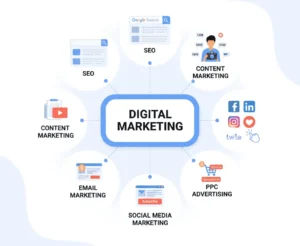
Let’s break down how digital marketing works by looking at its main channels:
1. Search Engine Optimization (SEO)
What it is: Making your webpage appear when people search on Google.
Real-life example: The first restaurants that pop up when you enter the query “best pizza near me? They’re using SEO.
Why it matters:
- 68% of online experiences are triggered by a search engine.
- Google’s first page receives 71% of clicks.
- It is free traffic (no advertising cost is paid
2. Content Marketing
What it is: Creating valuable content (blogs, infographics, videos) that attracts and educates your audience.
Real-life example: Recipe blogs that appear when you search “how to make chocolate cake”—they’re doing content marketing.
Why it matters:
- Content marketing is 62% cheaper than traditional marketing.
- Generates 3x more leads compared to outbound marketing
- Builds trust and authority
3. Social Media Marketing
What it is: Engaging customers through platforms like Instagram, Facebook, LinkedIn, and Twitter.
Real-life example: Brands responding to comments, conducting contests, creating viral reels, or sharing behind-the-scenes content.
Why it matters:
- An average individual spends 2.5 hours a day on social media.
- 78% of buyers find products through social media platforms.
- Direct channels of communication with customers.
4. Email Marketing
What it is: Sending targeted messages straight into people’s inboxes.
Real-life example: Those “20% off” emails from your favourite online store or newsletters you subscribe to.
Why it matters:
- 4 billion daily email users
- $36 return for every $1 spent (highest ROI of any channel)
- Unlike social media followers, you have control of your email list.
5. Pay-Per-Click (PPC) Advertising
What it is: It involves paying to display ads on search engines or social media (you only pay when someone clicks).
Real-life example: The “Sponsored” results at the top of Google, or ads in your Facebook feed.
Why it matters:
- Immediate exposure (as opposed to SEO that takes time)
- Businesses make $2 for every $1 spent on Google Ads.
- Precise targeting options
6. Influencer Marketing
What it is: Collaborating with social media celebrities to promote your product.
Real-life example: YouTubers testing gadgets and Instagram influencers who promote fashion brands.
Why it matters:
- Two out of three consumers believe influencer recommendations
- More interaction than brand-created content
- Connects with niche audiences effectively
Traditional Marketing vs. Digital Marketing
Aspect | Traditional Marketing | Digital Marketing |
| Reach | Local/Regional | Global |
| Cost | High (TV, print ads) | Lower, scalable |
| Targeting | Broad demographics | Laser-focused (age, interests, behavior) |
| Measurement | Difficult to track ROI | Everything is measurable |
| Interaction | One-way communication | Two-way conversations |
| Speed | Weeks/months to launch | Can launch campaigns in hours |
| Flexibility | Hard to change once published | Adjust campaigns in real-time |
How Digital Marketing Works: A Simple Customer Journey
Meet Sarah, an MBA graduate. Let’s follow Sarah’s journey to understand digital marketing for beginners explained:
Stage 1: Awareness
Sarah sees an ad on Facebook about running shoes → Social Media Marketing
Stage 2: Interest
She searches Google with the query “best running shoes for beginners” and comes across an informative blog → SEO + Content Marketing.
Stage 3: Consideration
She reads customer testimonials and watches YouTube reviews → Video Marketing + Social Proof.
Stage 4: Decision
She gets a 15% discount code via email → Email Marketing
Stage 5: Purchase
She clicks on a Google shopping ad and makes a purchase.→ PPC Advertising
Stage 6: Loyalty
She follows the brand on Instagram and posts about her purchase. → Social Media Engagement
See how various digital channels work together? That’s integrated digital marketing.
Key Benefits: Why Businesses Love Digital Marketing
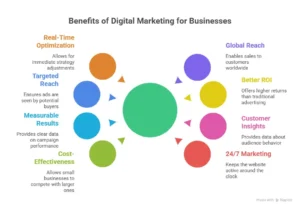
- Cost-Effective: Small businesses can compete with large corporations.
- Measurable Results: Clear image of what’s working and what’s not
- Targeted Reach: Show your ads only to potential buyers (people likely to buy).
- Real-Time Optimization: Adjust strategies according to performance
- Global Reach: Sell to customers all over the globe from your living room.
- Better ROI: Increased returns than traditional advertising.
- Customer Insights: Learn about your audience through data.
- 24/7 Marketing: Your website works while you sleep.
Common Digital Marketing Myths Debunked
Myth #1: “Digital marketing is only for large firms.”
Reality: Small businesses often see better results because they are dynamic and goal-oriented.
Myth #2: “You need a huge budget.”
Reality: You can start with $0 (organic social media, SEO) or as little as $5/day in ads.
Myth #3: “It’s too technical for me.”
Reality: It is accessible to everyone with easy tools. If you can use Facebook, you can learn digital marketing.
Myth #4: “Results happen overnight.”
Reality: SEO will require 3-6 months, whereas PPC can generate instant traffic. It is a combination of short-term and long-term strategies.
Essential Digital Marketing Tools (Most Are Free!)
| Tool | Purpose | Cost |
| Google Analytics | Track website traffic | Free |
| Google Search Console | Monitor SEO performance | Free |
| Canva | Create graphics | Free/Paid |
| Mailchimp | Email marketing | Free up to 500 contacts |
| Hootsuite/Buffer | Schedule social posts | Free/Paid |
| SEMrush/Ahrefs | SEO & competitor research | Paid (free trials) |
| Meta Business Suite | Manage Facebook/Instagram | Free |
Getting Started: Your First Steps
For Beginners:
- Create a website or blog (Shopify, Wix, or WordPress)
- Set up social media profiles on 2-3 platforms your audience visits.
- Start creating valuable content (respond to customer questions).
- Learn basic SEO (use Google’s free courses).
- Build an email list from day one.
- Experiment with small ad budgets ($5-10/day to test)
- Track it all with Google Analytics.
For Business Owners:
- Set clear goals (leads, sales, brand awareness)
- Get a deep understanding of your target audience
- .Select 2-3 channels to master first (don’t spread too thin)
- Create a content calendar.
- Consider hiring a specialist or agency.
- Be consistent and patient.
The Future of Digital Marketing
- The online world is changing at a fast pace. Here’s what’s trending:
- AI-powered personalization (chatbots, predictive analytics)
- Voice search optimization (as smart speakers become common)
- Video dominance (short-form content like TikTok and Reels)
- Interactive content (polls, quizzes, AR experiences)
- Privacy-first marketing (as cookies phase out)
Final Thoughts: What Is Digital Marketing in Simple Words?
Digital marketing is meeting your customers where they already are, online, and adding value at each step of their path. It is not about fooling people into buying. It’s about:
- Being helpful
- Solving problems
- Building relationships
- Creating genuine value
Understanding digital marketing is no longer an option, whether you are a student seeking employment options, a business owner looking to expand, or simply find yourself curious about how modern marketing operates. It is the 21st-century business language.
The best part? You don’t require a marketing degree to start. Anyone can learn the ropes in digital marketing with curiosity, consistency, and the willingness to learn.
Ready to dive deeper? Begin with one channel that interests you most, learn it thoroughly, then expand from there. The digital world is waiting!
Have questions concerning digital marketing? The path from an amateur to a professional begins with interest. Keep learning, keep experimenting, and remember—all experts were once novices.